
About
Jiri Geller has followed an unconventional career as an artist. Through his own talent and activities, and an unbelievable amount of work, he has arrived at a situation where he has a proper studio and the economic opportunities to create artworks that are demanding in both their techniques and materials. He has a background in craftsmanship and his philosophy is rooted in rock music, in which he also engages. Jiri Geller could well be described as an artist aware of the contemporary world and its situation combined with a fearlessly realistic attitude.
What is the underlying story of Geller’s art? Why does he make these large works requiring the continuous learning of new things, long days, economic investments, and solitary time and space for his own thoughts? Jiri Geller has said that he does not aim at a critical attitude, but to express awareness of what is dangerous and negative. In his own words, his works ‘are not about being critical, but about showing consciousness of the dangerous and the negative. The lure of the destructive and the glamour of the vulgar’.1) When considering Jiri’s art and thinking, one often arrives at a paradox, as with this statement. He speaks of ‘the destructive’ and ‘the vulgar’ in the same sentence, attributes that change at the same time to ‘lure’ and ‘glamour’. It is in the tensed intervals of these attributes and their oscillation that his art is made.

About
Like an anarchist who has studied every stitch and fold of the banker's suit, Jiri Geller models and subverts the iconic forms of contemporary culture with vengeful precision.
While – not inaccurately – self-defining as "an outsider, a punk rocker", Geller is also the rare Finnish artist who has both managed to stay close to Finnish aesthetic strengths and traditions and also detonate his own unique brand of post-national, mind-fucker nihilism.
As a Finn, Geller's work perfectly fits that grey Nordic outpost's proud, tragic tradition. His sculptures are elemental and essential, fascinated with death and violence, critical of the fake and phony, and ever aware of just how dark the world can be.
But then, rather than being limited by his roots – or in denial of them, Geller keeps to this impeccable conceptual framework, and takes it global. While never repeating himself, Geller targets the same territory again and again to explore the idea that what in our modern world is deemed solid, permanent and valuable is in fact melting, suspect, and utterly transitory.
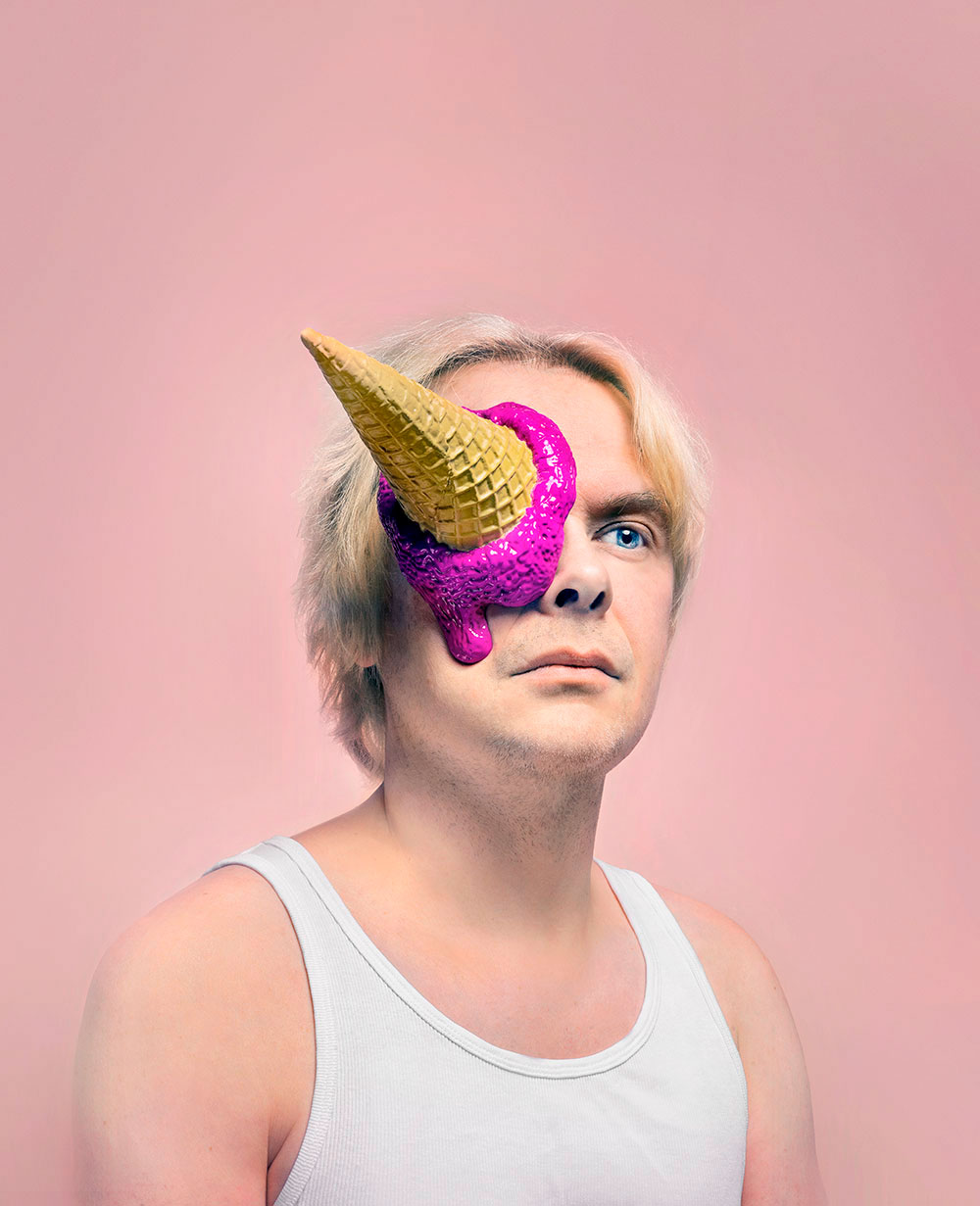
Geller's objects offer meaning despite their solidity and materiality. A pessimistic yet playful – at times quite profound – energy flows through them: escalators connect one to nowhere; fiberglass tsunamis promise leisure sport and/or death by flood; ice cream cones sit frozen in mid-melt next to exquisite skulls that melt and drip like butterscotch candies in the sun.
It's rare to see such playfulness and heaviness seamlessly combined in the same artistic vision: Geller's balloon fabrications radiate all the lighthearted joy of portraits of children...who have recently died. And he has constructed a video game control module possibly intended to burn you alive.
But if Geller's all sharp knives, dark jest and nihilist prankster, what's with a name linked to that slightly dated globe trotting charlatan asshole – Uri Geller? Jiri explains:
"Uri is friends with Michael Jackson - that is cool. And both Uri and I do tricks for a living. I like the way that people get suspicious when thinking they might be being cheated. Like: ´Could this guy's name really be Jiri Geller´. Well, they should be suspicious. We've all been cheated big time.”
– Mark Maher, Helsinki Finland, May 2010
Jiri Geller has followed an unconventional career as an artist. Through his own talent and activities, and an unbelievable amount of work, he has arrived at a situation where he has a proper studio and the economic opportunities to create artworks that are demanding in both their techniques and materials. He has a background in craftsmanship and his philosophy is rooted in rock music, in which he also engages. Jiri Geller could well be described as an artist aware of the contemporary world and its situation combined with a fearlessly realistic attitude.
What is the underlying story of Geller’s art? Why does he make these large works requiring the continuous learning of new things, long days, economic investments, and solitary time and space for his own thoughts? Jiri Geller has said that he does not aim at a critical attitude, but to express awareness of what is dangerous and negative. In his own words, his works ‘are not about being critical, but about showing consciousness of the dangerous and the negative. The lure of the destructive and the glamour of the vulgar’.1) When considering Jiri’s art and thinking, one often arrives at a paradox, as with this statement. He speaks of ‘the destructive’ and ‘the vulgar’ in the same sentence, attributes that change at the same time to ‘lure’ and ‘glamour’. It is in the tensed intervals of these attributes and their oscillation that his art is made.
BACKGROUND AND FRAMEWORKS
Pop art is the main frame of reference of Jiri Geller’s art, but for him it is not situated in the visuality of everyday life but mainly in the area of popular culture of which he has sovereign command. Geller draws upon its many genres, which he also combines unabashedly.
Richard Hamilton (1922–2011), one of the first protagonists of pop art defined its difference from the fine arts as follows: ‘The POP-Fine-Art standpoint, on the other hand – the expression of popular culture in fine art terms – is like Futurism, fundamentally a statement of belief in the changing values of society. Pop-Fine -Art is a profession of approbation of mass culture, therefore also anti-artistic. It is positive Dada, creative where Dada was destructive...
Jiri Geller’s art is ‘images of images’ defined with the term ‘simulacrum’. They have no referential relationship to reality or even the original sources of the images. Instead, they relate to other images, other ‘simulacra’. The flood of images is a basic tenet of the so-called ‘society of the spectacle’, but this whole notion is so central to the worlds of products and popular culture that we take it for granted that these images do not belong to the real world.
Jiri Geller speaks of the metaphorical nature of his art. The spaces and situations of his works resemble either abstracted space and time or in recent years the world of comic strips and animated films. On the other hand, the reference to metaphor concerns emotions and moods represented in the works that we recognize and may have experienced in our own lives.
Nonetheless, Jiri’s art extends beyond the boundaries of popular culture to transform into something else. This is his magic trick, which does not take place at the level of figures but in the way that he appropriates them for his own use and makes them recognizable. It is about what he does, and how. These works are often distinguished by highly polished surfaces, perfect forms and an industrial level of finish. They bring to mind Any Warhol’s famous comment from 1963, in which he says that he wants make art like a machine without bringing himself forth or leaving the mark of his hand: ‘The reason I’m painting this way is that I want to be a machine, and I feel that whatever I do and do machine-like is what I want to do.
In the case of Jiri Geller, however, this leads to a paradox. He does not make art
‘mechanically’ but in an ‘all-out’ manner, crafting his works. He uses machinery as an aid, but everything is treated, polished and painted. This, however, must not leave any marks of the hand on the finished piece. Geller says that a work is completed when it looks as if it was made effortlessly, as if it had come about of its own accord.
In the case of Jiri Geller, however, this leads to a paradox. He does not make art
‘mechanically’ but in an ‘all-out’ manner, crafting his works. He uses machinery as an aid, but everything is treated, polished and painted. This, however, must not leave any marks of the hand on the finished piece. Geller says that a work is completed when it looks as if it was made effortlessly, as if it had come about of its own accord.
Geller has said that he makes fetishes. ‘Fetish’ as such is an interesting term, originally referring to religious objects with miracle-working properties. Marx introduced the concept of so-called commodity fetishism, which has been actively cited in cultural theory in recent decades. It maintains that the production of goods and its stages are forgotten while the main focus shifts to the exchange value of goods and the ways in which identity, social roles and relations are constructed with goods and consumption. In other words, we express the class of society to which we belong with the goods that we acquire.
Jiri Geller introduces a new aspect to commodity fetishism, while effacing the marks of craftsmanship when speaking of his own art objects as fetishes. In order to understand the value of these objects it is important to know that even though an object appears to be ‘machine-made’, it has required an unbelievable amount of work by hand. In this respect, it is a paradox in terms of the Marxist notion of fetish. Its real value as based on its stages of preparation is, in a sense, masked. Recognition and awareness of this masking accentuates the value of an object as a fetish. It is not just any object but specifically an art object made by hand. In some respects, this seems to be the hybrid of a religious, miracle- working fetish and a commodity fetish expressing cultural awareness.
Jiri Geller refers to his own works with the term ‘customization’, defining it in the following terms: ‘My own assembly line harks back to the ideology of the mass production of the basic Ford automobile. People went on customize these products, redesigning their appearance and making them individually their own. Ed “Big Daddy” Roth was among the first to commercialize this trend in the 1950s and 1960s. It is known as the South California “hot-rod movement” or “custom culture.”6) Customization in broader terms is a method applied by Jiri Geller. He ‘customizes’ known pop-art imagery and objects into his own messages and unique works of art.
Jiri Geller refers to his own works with the term ‘customization’, defining it in the following terms: ‘My own assembly line harks back to the ideology of the mass production of the basic Ford automobile. People went on customize these products, redesigning their appearance and making them individually their own. Ed “Big Daddy” Roth was among the first to commercialize this trend in the 1950s and 1960s. It is known as the South California “hot-rod movement” or “custom culture.”6) Customization in broader terms is a method applied by Jiri Geller. He ‘customizes’ known pop-art imagery and objects into his own messages and unique works of art.
In broader perspective, this method is also associated with a current in art known as ‘postproduction’. The French art theorist and curator Nicolas Bourriaud, who introduced the term describes it as follows:
‘No public image should benefit from impunity, for whatever reason: a logo belongs to public space, since it exists in the streets and appears on the objects we use. A legal battle is underway that places artists at the forefront: no sign must remain inert, no image must remain untouchable. Art represents a counter-power. Not that the task of artists consists of denouncing, mobilizing or protesting: all art is engaged, whatever, its nature and its goals. Today there is a quarrel over representation that sets art and the official image of reality against each other; it is propagated by advertising discourse, relayed by media, organized by an ultralight ideology of consumption and social competition.
In our daily lives, we come across fictions, representations, and forms that sustain this collective imagery whose contents are dictated by power. Art puts us in the presence of counter-images, forms that question social norms. In the face of the economic abstraction that makes daily life unreal, or an absolute weapon of techno-market power, artists reactivate forms by inhabiting them, pirating private property and copyrights, brands and products, museum-bound forms and signatures. If the downloading of forms (these samplings and remakes) represents important concerns today, it is because these forms urge us to consider global culture as a toolbox, an open narrative space rather than a univocal narrative and a product line.
This way of thinking can be seen in Jiri’s art, in which the imagery of popular culture is a tool kit used for personal artistic goals. ‘Customization’ can also be regarded as a form of ‘postproduction’.
Geller aims at seduction, which as noted above, also involves deception. He wants to present something perfectly fine, beautiful and perfect down to its details. This aim relates his work also to the core heritage of aesthetics, perhaps expressed in his observation: ‘I want to make art that looks better than reality – an eternally abiding moment of joy.’
In this respect, he sees an affinity with illusionists. He originally took the surname of the notorious Uri Geller as his pseudonym. He finds a similarity in the ways in which Uri and other illusionists deceive the senses of the viewer. My conversations with Jiri have also revealed his skepticism about what we actually see. He points out that nothing that he makes is perfect, but his reputation in this respect might mislead the viewer – i.e. to avoid seeing failings or minor errors – and he says that we see what we want to see. This is no doubt about his own powers of observation, but the general theory of seeing supports this notion. We also know this from our own experience.
IMAGE AND MUSIC
The differences between Jiri Geller’s visual and musical interests reflect an interesting opposition. Where his craftsmanship is silent, focused work of humility, the punk rock that he prefers is explosive and bound to the present moment, and in its most authentic form does not follow any ‘rules’. For Geller, rock is hedonism, a pure and problem-free alternative consciousness. Music is also interaction for him, with the immediate return of energy that is given. In art, other hand, feed-back and interaction have a time-lag. The making of art calls for a different daily rhythm and social behavior corresponding better to the norms of society. It may also require a long stage of preparation, planning and thinking leading to an insight or act that is perhaps realized in a single moment.
On the other hand, Jiri also aims in his images at pure joy and pleasure in the manner of rock music, ‘an eternally abiding moment of joy’. Both involve the necessity of freedom. For Geller, this is associated with the responsibility for doing things properly that extends to minor details. He could well be described as a ‘control freak’, in his case in a positive sense.
ROR: REVOLUTIONS ON REQUEST
The ROR group initially consisted of fellow art students and similarly minded young people at the very beginning of their careers as artists. They had different educational backgrounds, but many of them were close to craft and design. The early stages of the group may well be described by the following statement from their elaborately worded manifesto in the catalogue of their Utopia exhibition: ‘ROR-tuotanto [ROR Productions] is a cooperative in the process of being founded by young, unemployed people in Helsinki. Its members offer the production of prototypes and trial production series, design services for product concepts, graphic models and brochures and Internet-based marketing. Future clients will, for example, be inventors, innovation firms and private individuals.’
For a short while, one of the members, however, was Alvar Gullichsen (born 1961) who had a traditional training as an artist. He also helped the group by allowing them to use his studio to prepare their exhibition at the Kiasma Museum of Contemporary Art in 2001. The group’s main interest, however, was crystalized in the question of ‘what is art’ or of the moment when something turns into art. This provocative attitude introduced into art by Marcel Duchamp was launched almost a century ago, but it is still topical. For the ROR group, it was a question of different objects and techniques. An example of their work is the inclusion in the Utopia exhibition of a device invented by Matti Laurell, an inventor of the older generation, without Laurell being aware of it. ROR was at its largest at the time of the exhibition, including, along with Jiri Geller, Jessica Leino, Panu Puolakka, Heikki Ryynänen, Karoliina Taipale, Alvar Gullichsen, Klaus Nyqvist, Juha Mäkelä and Tiina Schreck.
All the artists of ROR implemented their own views, which permitted individual freedom. The group’s membership varied from one exhibition to another, and in its last stages it consisted of Jiri Geller, Klaus Nyqvist (born 1976), Panu Puolakka (born 1972) and Karoliina Taipale (born 1973). Max Ryynänen, who followed the group’s work from the outset and assisted it with his texts pointed out: ‘Geller has always been the force around which ROR has assembled. He has challenged its other artists to exceed themselves and has served as an intellectual antenna for the group – repeating the band scene of his youth (Isebel’s Pain). If an exhibition was at risk of being too sweet, he worked an edge to it – and when the dynamics of the group came apart he focused on secreting glue for it. ROR’s success as a group is due to him.’10)
ROR held an exhibition at Kiasma in Helsinki in 2001. This had been preceded by its Terror 2000 exhibitions in Helsinki, Stockholm and Reykjavik. The Kiasma show was entitled Utopia and it went on to tour with this name in several European countries, being included in, among other events, the Manifesta biennial in Frankfurt-am-Main in 2002. In the following year, ROR was also featured in the large Utopia Station exhibition at the Venice Biennale.
The years 2003–2004 are an interesting, if short, period by which time the original ROR of a varying number of regular members and visitors had become a core group of four persons with a gallery in the Kallio district of Helsinki. The gallery was planned from the outset as an art project funded with grants. Nonetheless, it probably taught the participants a great deal about planning and installing exhibitions, carrying out projects and the dynamics of the ‘art world’.
The next milestone was an exhibition at the Mori Museum in Tokyo in 2005, for which Jiri Geller made his hitherto most demanding work, The Big Time. It required approximately one and half years of full-time work and volunteer assistance from all of Jiri’s friends and acquaintances.
The years 2000–2008 were also an active international period for ROR. Geller did not hold his first solo exhibition until 2006, in the Korjaamo Gallery in Helsinki. The ROR stage was important for Jiri. It probably also served as a kind of period of preparation for his future solo stage. In addition, Jiri’s method of working is so slow that his output might not have been sufficient at this stage for solo displays. On the other hand, he spent a great deal of time on managing the affairs of the group and drawing up new plans.
THE PHASES OF MAKING ART
╸PROLOGUE
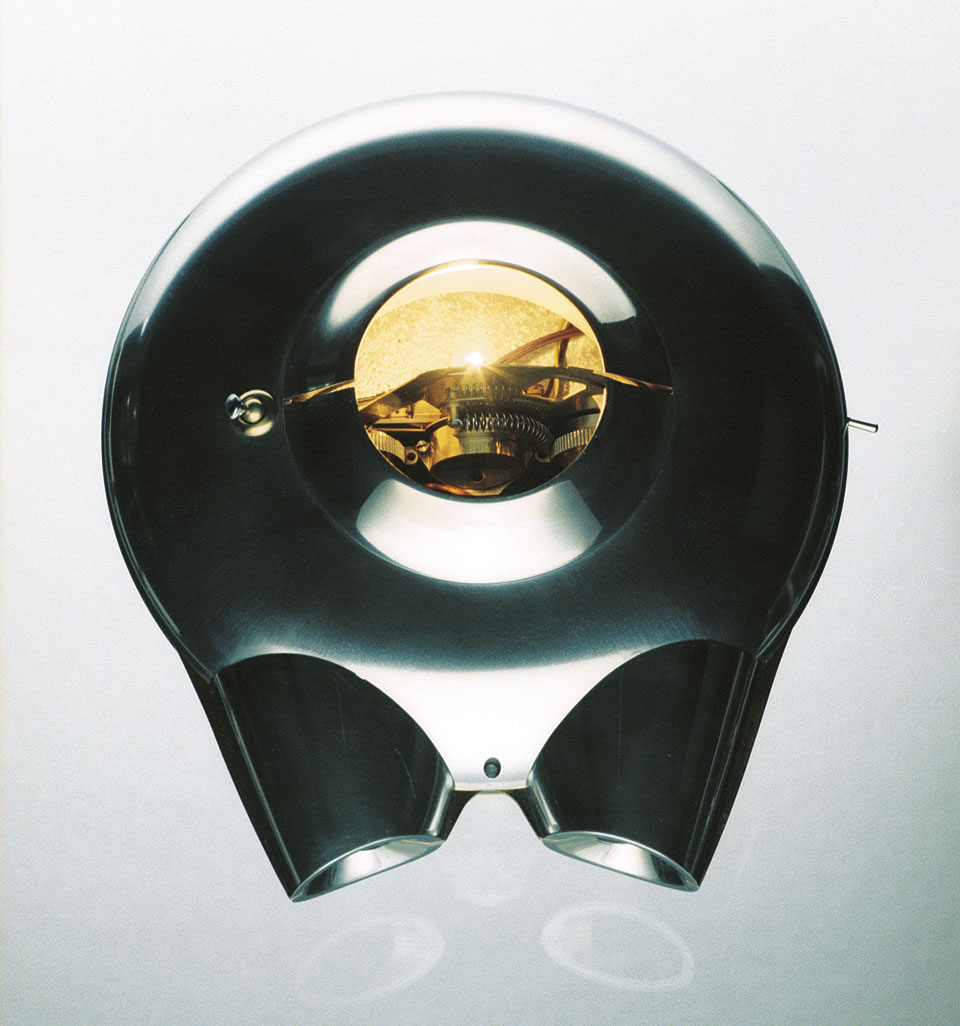
The history of Jiri Geller’s sculpture falls, in my opinion, into a prologue followed by so far two distinct stages. Lucid Dream from 1998 can be regarded as a kind of prologue to the work that was to come. Art critic and Finnish design expert Kaj Kalin had told him to offer this work, which was to become a View-master piece, for the collections of the Museum of Contemporary Art (present-day Kiasma Museum of Contemporary Art). Kalin had got to know Jiri’s work while serving on an international panel that commented on graduate projects at the goldsmithing course of the Lahti Design Institute. Jiri’s project was three different dental instruments of aluminium. Since the school focused on precious metals, material differing from this line was a definite protest. Kalin encouraged Jiri to continue his original work. The museum was interested in Lucid Dream, but the piece was not yet quite finished. It was gradually completed and purchased by the museum in 1998. Lucid Dream is an extremely delicately crafted object, with all its parts hand-made, which required consultation with professionals in various fields, one example being the grinding of the special lenses required by the device.
LUCID DREAM
The View-master is a stereoscopic viewer in which a disc of three-dimensional pictures is rotated. The images in Lucid Dream are a kind of allusive autobiography, but at the same time the visual motifs contain many references to future subjects. The object itself resembles a ‘flying saucer’ and the image of a spaceship launched to other planets anticipated his present works of space-related themes. The choice of his own biography as the subject of the images, albeit allusively and surrealistically toned, resembles the ways in which authors use material from their own lives in their first published works. Lucid Dream was an important work, making the artist aware that its silent personal nature did not seem to function in the unique exhibition situation that requires the viewer to be ‘an individual in a community’. It aroused and challenged the artist to study other possibilities that would be better suited to the world of art exhibitions.
╸THE FIRST CHANGE OF COURSE
The result was the first major change in Geller’s work. It was now time to expand the symbolic register and to take into account the social nature of the exhibition situation. The spirit of the period was marked by the breaking down of the Berlin Wall in 1989 and the ensuing feeling of freedom and optimism about the future. There was also the expectation of a new millennium and the belief that things would turn for the better. Jiri moved from small objects to a larger scale.
BATTLE OF THE WORLDS
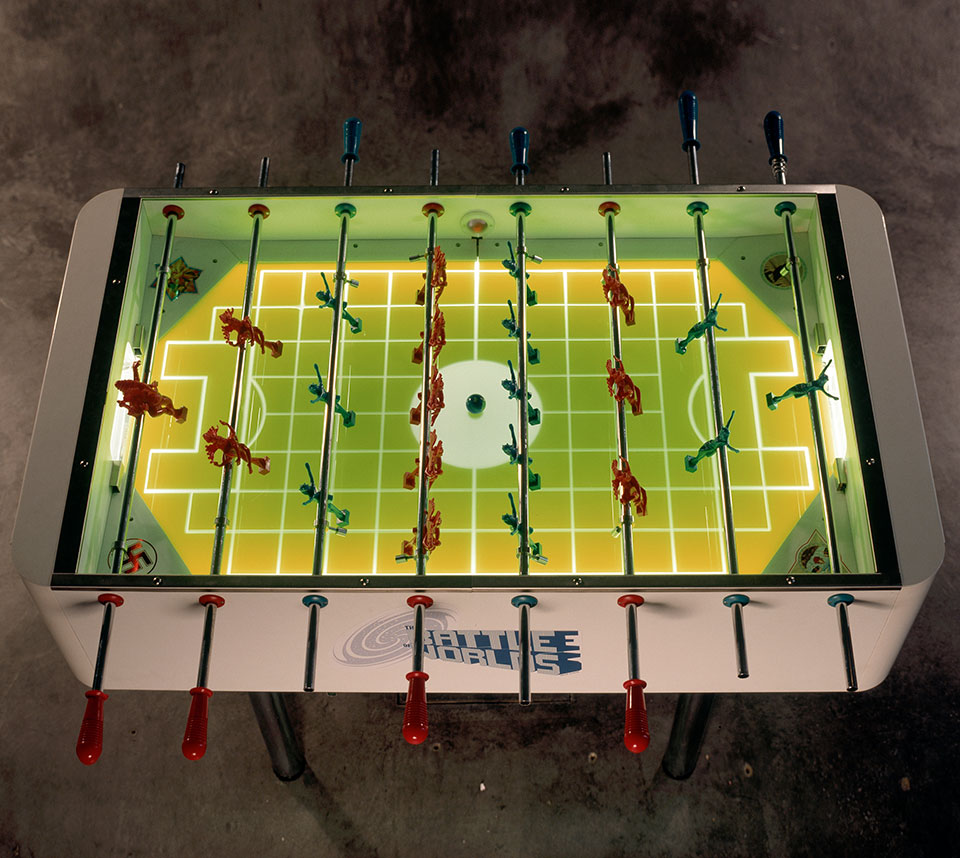
His first work of this phase was Battle of the Worlds (2000), showing Hindus and Christians playing table football. The stages of the game are accompanied by an audio world accompanying the game with comments and barracking. According to Jiri, the audio world is ‘shooting its mouth off’ about the players. The transition from the world of Lucid Dream and its silence is a major one. The game is noisy and its participants are also shown celebrating their goals.
The world and the first decade of the century, however, changed radically already in the following year as a result of 9/11. The result was a period of surveillance of unprecedented extent.
GOD SAYS NO
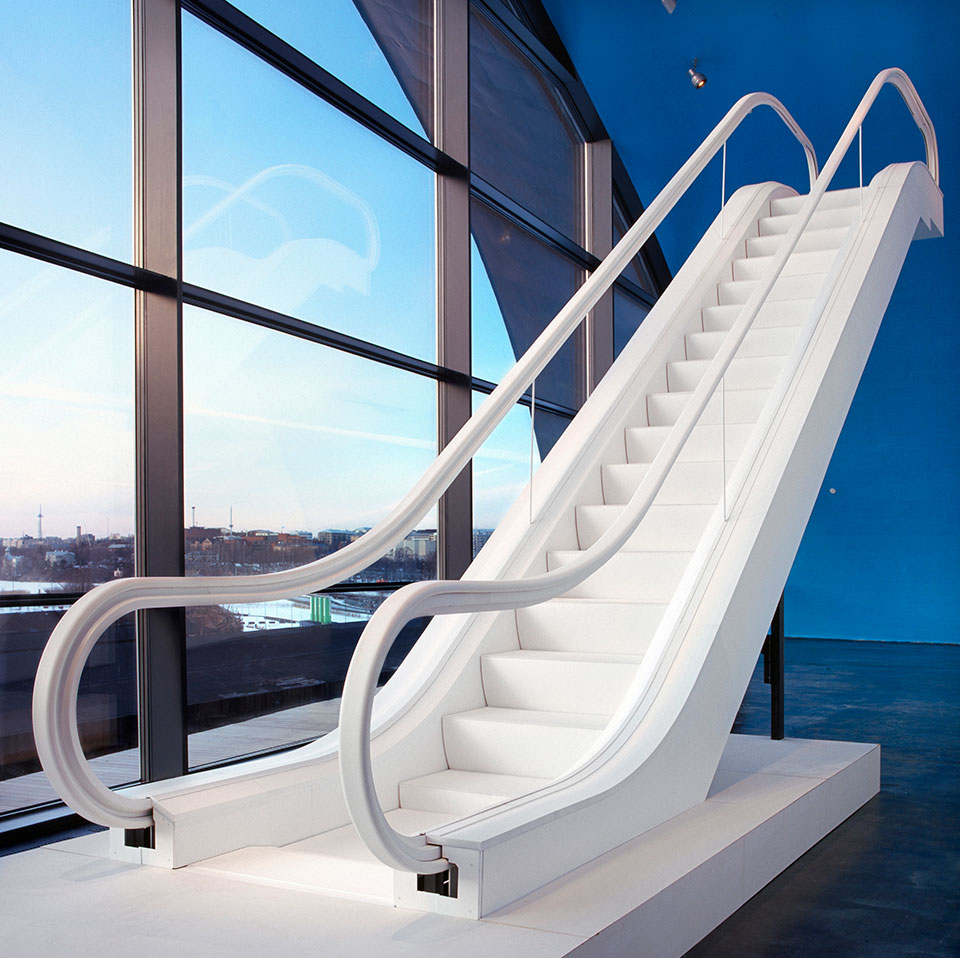
God Says No, made for the exhibition at Kiasma, was the next major work, showing a white escalator leading nowhere or ending in a void. It is as mute as Battle of the Worlds is noisy. It was named after a song by the rock group Monster Magnet. God Says No introduced a new seriousness to Geller’s art, prefiguring in a way his next work representing a gigantic wave.
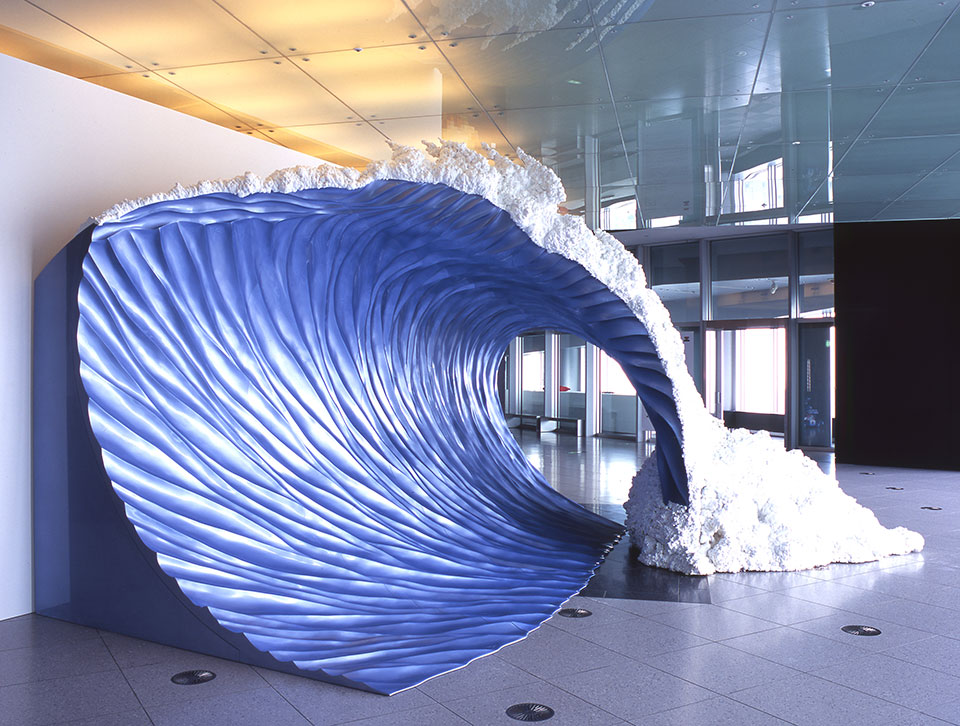
THE BIG TIME
This piece was given the title The Big Time. At the time when the name was coined, The Soundtrack of Our Lives group, admired by Jiri, held a concert in which a rock piece with the title The Big Time aroused in him an all-encompassing feeling extending everywhere that was as strong as the one created by the work in progress.
It is in some way disconcerting that Geller was working on the piece while a tsunami hit the South-East Asian coast on Boxing Day 2004. His work has been often compared to the Japanese artist Hokusai’s (1760–1849) series of woodblock prints on the theme of a large wave. Jiri’s wave is a structure over three meters high in which the moment of the wave, lasting seconds, is frozen ‘for eternity’ in the manner of a photograph. Artist and researcher Jyrki Siukonen has aptly described this work as follows: ‘By arresting the movement of the wave, Jiri Geller constructs the antithesis of the perpetual motion machine; he stops time. The grandeur of this attempt lies in its impossibility.’11)
╸THE SECOND CHANGE OF COURSE
After The Big Time, Jiri Geller went on to works of smaller scale, which were also in series. The core elements of both, however, had been present since the beginning of his work. The biggest change was repeated seriality, expressed as variations and combinations of the same motifs. This seriality can be regarded as a gradually forming larger entity, a kind of oeuvre consisting of and combining different themes and being constructed one work at a time.
The subjects of Geller’s works have included outer space and religious figures since the very beginning. He has now added balloons, skulls, ice-cream cones and fireworks to the motifs – and recently also smileys and astronauts. Seen in traditional terms, none of them are original; they all come from existing imagery individualized to become something new. Jiri delves directly into the world of these image, applying Donald Duck and Jesus alike, but adding to them attributes from another, perhaps equally well-known context, such as a skull or a crown of thorns.
These visual elements are used for making new images related to the present time and its consciousness. The skull has a long history as a motif in art, but in Jiri’s work it is treated like Donald Duck, played with, ‘sugared’, made to flow and given a crown of thorns. In a golden version, it has a diamond in its eye, perhaps as a sign of greed. The same elements reoccur in different combinations leading to series with different moods. There are skulls and ducks under the labels of both Dead Boy and Sugared. The scales of emotion of the balloons range from Happy, Happy Together (three balloons) to the theme of Dunkelheit (Darkness) with its glossy, reflective black surface. The skull motif combined with the crown of thorns appears in the same way in the Dead Boy series and the garishly neon-colored Dingdong series.
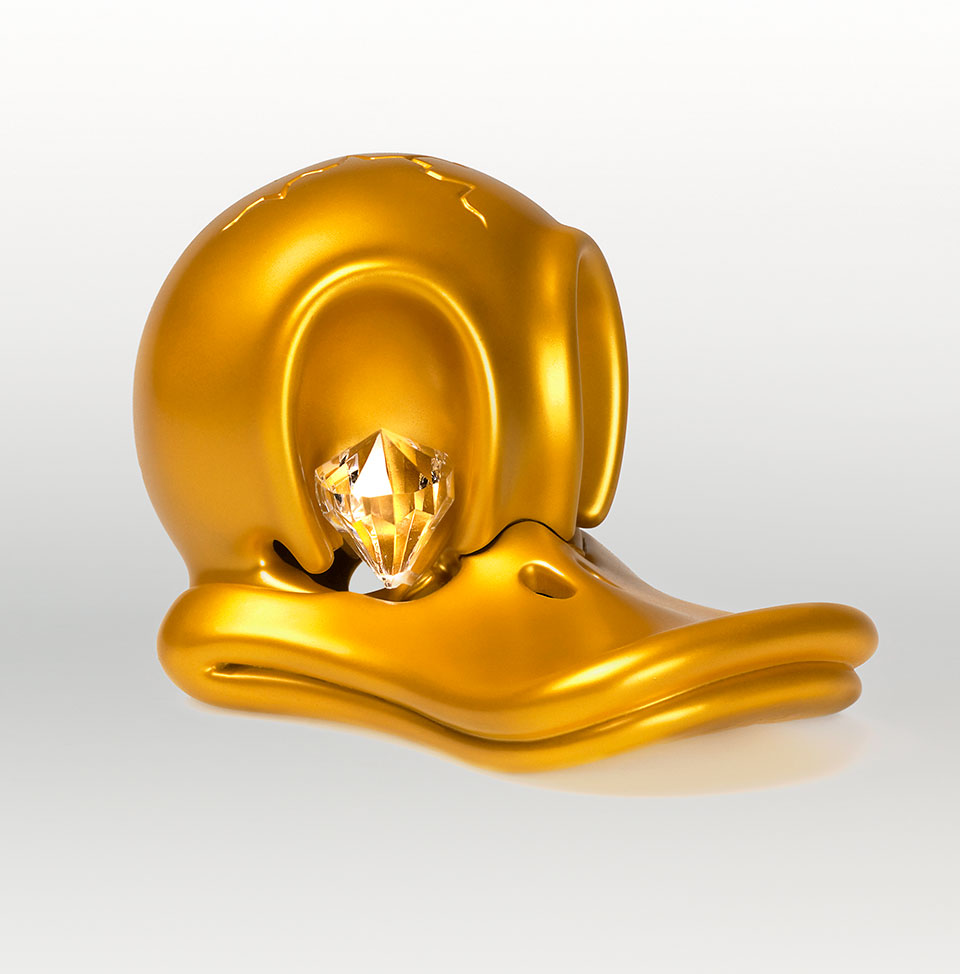
These visual elements are used for making new images related to the present time and its consciousness. The skull has a long history as a motif in art, but in Jiri’s work it is treated like Donald Duck, played with, ‘sugared’, made to flow and given a crown of thorns. In a golden version, it has a diamond in its eye, perhaps as a sign of greed. The same elements reoccur in different combinations leading to series with different moods. There are skulls and ducks under the labels of both Dead Boy and Sugared. The scales of emotion of the balloons range from Happy, Happy Together (three balloons) to the theme of Dunkelheit (Darkness) with its glossy, reflective black surface. The skull motif combined with the crown of thorns appears in the same way in the Dead Boy series and the garishly neon-colored Dingdong series.
There is often a humorous vein in the works, which can become serious in the blink of an eye. One reason for this is no doubt Jiri’s visual language, which at first sight arouses a happy feeling of recognition that the viewer associates, for example, with the world of comic strips, but with an almost simultaneous flash of memento mori.
Where do these unorthodox combinations stem from? They contain something from the surrealist worlds of dreams, bringing to mind here a series of images in Geller’s early Lucid Dream. Jiri himself speaks of a different level of consciousness, associating this with the culture of the West Coast in the United States, where expanded consciousness was sought with various means.
On the other hand, this is about traditional surrealism in which things alien to each other are combined to create new meanings. Jiri has noted that he feels that he is making magical objects. The word ‘magical’ has a natural connection with the imagery created by surrealism. In this context, reference is often made the Comte de Lautréamont’s poem ‘Maldodor’ (1869) with its depiction of a young poet ‘... as beautiful as the chance meeting on a dissecting-table of a sewing machine and an umbrella’.
EVENTS
Arrested situations are natural motifs in Geller’s art. However, he has also made a series of works that are put into action mechanically. Battle of the Worlds is based on participation associated with an audio world. Other examples are Continue? (2002) in which a game controller bursts into flames and Lick It Up (2014). In the latter, a masked man (Gene Simmons of Kiss, known for his demon mask) is mechanically licking his tongue.
Geller’s works of recent years go back to the static event. A central one in this connection is Don’t Touch the Artwork, in which the stand of a piece of sculpture has crashed down on a viewer, leaving only the hands and feet of a Mickey Mouse figure visible. The idea came from a permanent sculpture stand in Tampere on which public works of art are placed for a set period. Jiri suggested showing a viewer crushed under the stand. This was not done in Tampere, but it led to the sculpture. Mickey’s butler glove also appears in Pay on Time Motherfucker, referring to a potential threat. This piece has been made in both right and left-hand versions. According to Jiri, it refers to both the Mafia custom of reminding about unattended obligations and to Mickey Mouse as an annoying metaphor of the American way of life.
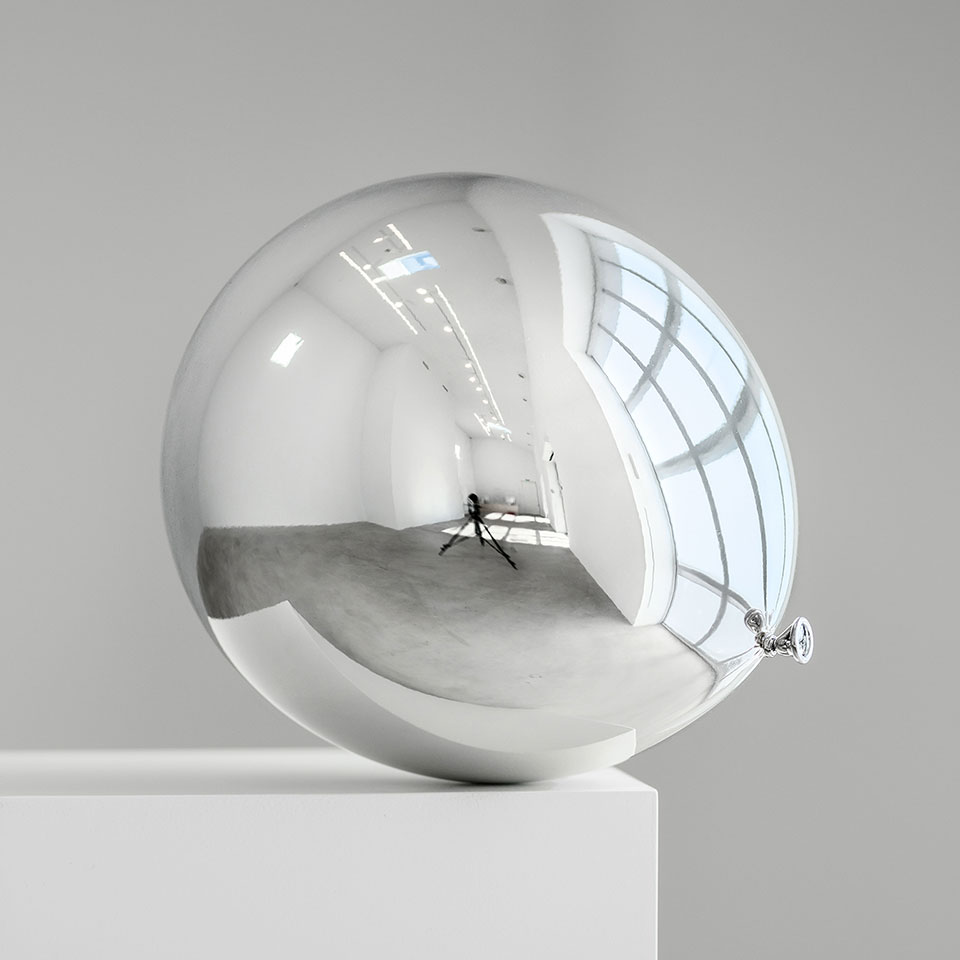
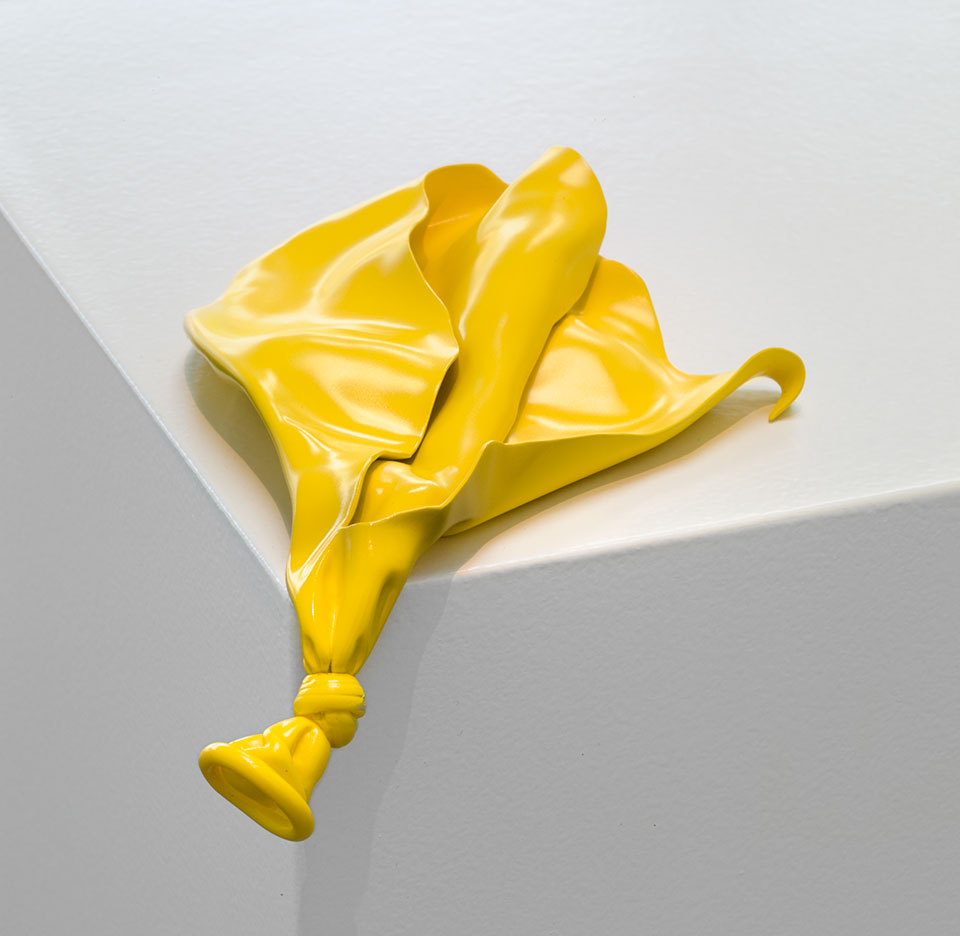
Balloons, skulls, ice-cream cones, Donald Duck, fireworks, smileys and astronauts have different roles in different thematic series. Sugar/Sugared describes both an explosion (Sugared Forever) and a balloon (Sugar Happy). Dingdong is a series of gaily coloured Donald Duck figures wearing crowns of thorns. Series of Disappointments (2008) consists of four intact ice-cream cones and fifth one emptied by melting. It depicts precisely the moment when ice-cream flows out of a cone and we realize what has happened. The balloons carry on this depiction of an action arrested in a moment. The balloons are of fiberglass, but they hover lightly if seemingly against the laws of physics. They also express various states and situation, such as Sugar Happy, Sugared and the three-balloon series Happy Together. This series also includes a version depicting an accident, showing a burst balloon with the title Fucked, in Finnish ”vittumäoonihanriekaleena”, literally ‘Fuck, I’m all in torn up’.
COLORS
Neon colors led to representing situations of a new kind, and Geller’s earlier themes were also given the neon treatment. Sugared was given different versions in the forms/figures of the balloon and skull, and as fireworks. We all know the unhealthy effects of excessive sugar consumption and the state similar to slight intoxication that it produces. The series also contains a ’realistic’, skin-colored ‘pot belly’ that stands out from the rest of the work. Jiri says that he himself tends to eat too much that is sweet and the flabby belly is to be a reminder of the dangers of consuming sugar. At the same time, it brings down to earth the enticing sweetness of ‘sugaring’. All the works with the fireworks theme are based on the arrested moment. In addition to fireworks, inspiration was provided by the remains of grinding and polishing various metals that Geller saw in his studio, burning and spluttering in different ways and different colors. Jiri noted that ‘I found myself trying to capture a vision of light or fireworks, a feeling of happiness, the upward bubbling of bliss, or an orgasm as a picture.’
Balloons were the theme of Geller’s solo exhibition held in 2008 in connection with the Kiasma museum’s 10-year anniversary exhibition. At this stage, the color scale still included the familiar black, white and beige – though now accompanied also by yellow and bright red. This color scale is not typical of popular culture and is identified rather as belonging to high culture. Around 2011, Geller became interested in neon culture, which since then have had a clear and central role in his art. In his preface to a book on the use of neon colors, which was published in Hong Kong, he says that his interest in neon colors was due, among other reasons, to the techno-culture of the 1990s, which experimented with new forms of consciousness. ‘Neon colors are alarming yet alluring. I want to make works of art that look better than reality. Neon expresses a different state of mind and consciousness. It’s an alienating trick.’
FLUIDS ╸DRIPPING, FLOWING AND SPLASHING
The liquid state, everything that flows, is Jiri’s next focus of interest. The Polish-English sociologist Zygmunt Bauman (1925–2017) saw in the movement and adaptability of fluids a key metaphor of our whole (post-) modern age. ‘Fluids travel easily. They “flow”, “spill”, “run out”, “splash”, “pour over”, “leak”, “flood”, “spray”, “drip”, “seep”, “ooze”; unlike solids, they are not easily stopped – they pass around some obstacle, dissolve some others and bore or soak their way through others still.’
It feels as if Bauman were describing, with these verbs representing the modern age, Jiri Geller’s new series of sculptures and their manners of action. For Geller, works depicting actions contain both fluids and static elements representing flow. This subject-matter is familiar from contemporary images in Jiri’s own words, ‘everything splashes in today’s advertisements’. We Come at Night (2014) is a staged action. The black skull of this sculpture dives into a world of black fluid when the viewer approaches it. The original idea of the piece was a ‘shy sculpture’. In Kill Your Darlings (2017), three black skulls attached to each other are falling into the crown-shaped part of a splash caused by a drop of fluid.
SMILEY AND ASTRONAUT
The smiley has been an important motif in Geller’s art in recent years. He has made three- dimensional sculptures of the classic smiley, but using only one of its expressions. This is the classic smiley, the wide smile expressing overflowing enthusiasm. The exhibition includes a smiley of cast aluminum stretched in the spirit of Giacometti’s sculptures. The line of the smile is engraved in the metal surface and marked with a black line. The artist hopes that the smile will not suffer not same fate as the sculptures of Antiquity, the original colors of which were not discovered until centuries later. The smiley expresses joy, encouragement and acceptance. It is all things positive, although its message is radically simplified and it functions mainly as a punctuation mark. On the other hand, it resembles a child’s first drawing of a human being. A round head with eyes and a mouth is among the first images with which a child perceives the world.
The smiley is based on a symbol developed in the United States in the 1960s to
encourage workers in companies to produce good results. The smiling face, or smiley, has its own history and culture and must not be confused with contemporary emojis. The smiley is in universal use; it truly feels like an image that transcends culture. Jiri also follows the principle of making sure that the images that he uses will remain fresh and not become obsolete. He maintains that the smiley is one such image, like logos, Playstation or the escalator symbol. They are both current and timeless. A question to be considered is whether these instant symbols of emotions already constitute a kind of vernacular sculpture or image for every home that could become just as common as popular printed reproductions of artworks have been in the past.
CONCLUDING REMARKS
Jiri’s works operate on a wide scale of emotions. Their multi-layered and contradictory nature is demanding for the viewer. The serial elements require the viewer to be ‘awake’, to be prepared to rethink what one sees and to dare to set out into new territory. Here – as in contemporary art in general – it is understood that viewers complete in their minds the meaning of the work. The notion of the viewer’s participation has been a central one in recent decades. Marcel Duchamp already stated in the 1950s that art is created in the mind of the viewer. ‘All in all, the creative act is not performed by the artist alone; the spectator brings the work in contact with the external world by deciphering and interpreting its inner qualifications and thus adds his contribution to the creative act.’
Jiri Geller’s transition from the serious and to some degree apocalyptic considerations of his early years to the present situation and rhetoric not only concerns the message of his works but is also expressed in his view of the artist’s role in relation to his works. In moving on to small works depicting static situations and action, Jiri Geller relocated himself alongside the viewer. He no longer addresses viewers but considers things in wonderment together with them, things that are serious, amusing, sad or amazing. Life and the world are a strange theatre, but with a dynamic that is worth being aware of.